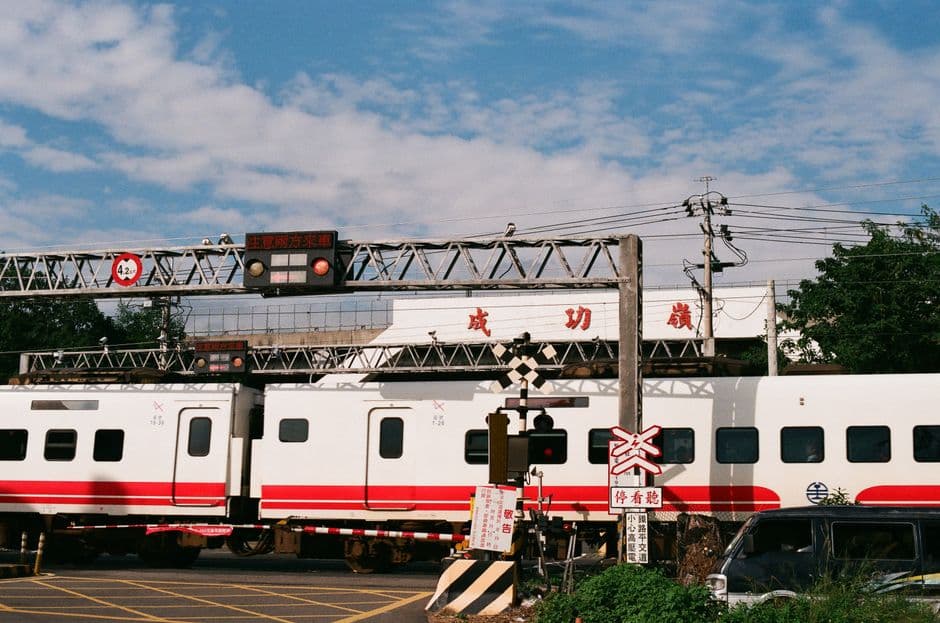
The branch manager gave the town route to whoever finished both country rounds by 5:50, and the town route paid triple because you also collected on the first of the month. I cut through the Fujimae crossing at 4:40 to make my time, when the only other thing on the road is fog coming off the harbor. The alternative was the footbridge two hundred meters down, built high for coastal freight, and pushing a loaded bicycle up its ramp and down the far side cost forty minutes I did not have.
My grandfather drove coastal freight for thirty-one years and had one rule he ever bothered repeating. When the lights are on, that ground is not yours. He said it about the Fujimae crossing in particular, the way other families say grace.
The crossing was automatic. Two arms, four red lamps, a bell in a steel cage, and a white line across the road that everyone in town stopped behind whether or not a car was coming, because you learned that line before you learned to read. Freight ran twice a day, 11:20 and 15:05. At 4:40 nothing ran at all, and had not since the quarry spur closed, the year my mother started primary school.
In October of my second year, the crossing began running anyway.
Ten Yen
The first time, the lights came on at 4:37, the bell went, both arms dropped, and nothing came. Rails sing when a load is coming — grandfather again — so I stood behind the white line and listened to the pitch climb the way a loaded pitch climbs, and after three minutes the arms lifted and the bell cut off and I made my round with ninety seconds to spare.
The station office log said the crossing had not activated. The clerk was kind about it, the way you are kind to a boy who has miscounted his own morning; he turned the printout so I could run my finger down the column myself. 11:20. 15:05. Nothing else, for thirty days.
Four mornings later a second freeze came at 4:49, ten minutes after I had crossed. From up the road I watched the arms hang across an empty road for three minutes. The next came at 5:01.
I did what any seventeen-year-old railway obsessive does with a crossing that runs without trains. On the fifth morning I taped a ten-yen coin to the head of the far rail with aluminum tape from the hardware shop and stood back of the line. Lights, bell, arms. The rails sang longer than the bell did. When the arms rose I peeled the tape.
Aluminum foil. The coin pressed thin as foil, cool in my palm, and the tape unscorched. It sits in a film canister in my desk at my parents’ house — a bright wafer with the little temple hall smeared wide, stretched like toffee.
Something crossed. It had weight, it took three minutes to pass, and the circuit, said the printout, had never closed.
The Extras
Bolted to the crossing’s control box hung a glass case, the kind timetables used to live in, fogged with grit since before I was born. In November I scraped a porthole clean with a coin edge and read it.
A photocopy, browned to the color of tea. SPECIAL EXTRAS — HEAVY PATHS, APRIL 1971. Below the heading, a single column of twenty-six times running down the page, 04:40 at the head, 23:58 at the foot.
The quarry spur was still open in 1971. Everybody knew that much, and everybody also knew that a posted schedule has to be formally withdrawn before it stops being posted, and withdrawal paperwork goes missing the same way everything goes missing in a town-office basement that floods every June. What nobody had thought through was the other half of it. A schedule that was never withdrawn never stopped being a schedule.
I copied the column into my round notebook and kept times. Eleven straight mornings matched to the minute. 04:40, 04:49, 05:01, 05:11, 05:20 — the runs were going down the list in order, one line per night, and the list went on into 06:05, 07:20, the school hours, the hours the whole town crossed. Twenty-six lines. Twenty-six nights, and after that the day belonged to the sheet.
I took the foil wafer to the station office a second time. The clerk filed it under non-ferrous scrap, one piece, and gave me a receipt, and that receipt is the only place the crossing’s morning run was ever recorded by the railway.
The Under-Arm Rule
On the morning of the 05:11 line I stood at the white line on purpose, notebook in my basket, because I wanted to see what a heavy path carried.
Nomura crossed at 5:09. Junior school, fifteen, small for it, glasses that fogged off his face when he exhaled; his basket rode high because his papers were folded wrong. The lights came on while he was on the seam, and both arms dropped together, the far one clipping his rear wheel, the near one landing behind his back.
He did the one thing every child in that town is drilled never to do. He dropped the bicycle and went for the gap under the near arm, and his jacket snagged.
The rails had begun to sing.
My grandfather’s rule has an underside he never put into words, because the top of it was for children. The lights mean the ground is not yours. The underside: if someone you know is standing on that ground, you go take them off it, and you have about four seconds to decide, because the arms lock once the circuit occupies and after that you are a spectator.
I crossed the white line against the lights, got Nomura by the collar and the belt, and folded him under the near arm with my knee in his back. The bicycle stayed on the seam.
No train came. The bell ran, the rails sang a loaded note, Nomura breathed against my arm in small bird counts, and then the bell stopped and the arms rose.
The bicycle had become a sheet. Folded twice, the way you fold a letter for a small envelope. Frost stood on it in needles, on a morning too warm for frost anywhere else, and the blue of the frame had gone through the metal, so the sheet was blue all the way through, as if the paint had been printed into it. No heat. No debris. The bicycle’s bell sat inside the fold, uncrushed, ringing faintly until I picked it out and it stopped.
The police report says the bicycle could not be located. The town called it vandalism, which is the word a town uses for a compression.
The New Sheet
The school moved its walking route to the footbridge in December.
NOTICE: With regard to the Fujimae crossing, pupils are asked to use the harbor footbridge until further notice. The change is administrative.
Administrative. My grandmother read the word out loud at dinner and slid the circular under the soy dish to stop it sliding.
I moved my round to the bridge as well. Forty minutes both ways, no town route, and the branch manager gave the pay to a boy from the harbor side who believes none of it. From the bridge at 4:40 you can see the whole crossing the way a gull sees it.
The runs went down the 1971 column all winter, line by line, into the school hours and out the far side. Nobody discusses the 07:20.
In March the railway replaced the glass in the case. New bolts, clean putty, and inside a fresh photocopy — the same browned sheet, the same twenty-six lines, aged to fool you. Below 23:58, in the current format, in ink that had never seen weather, one line more:
04:40 — TOWN SERVICE — STANDING
The twenty-six originals will finish at the foot of the list and the sheet will close, and then only the standing line remains, and the standing line runs daily, three minutes, bell and lights, arms down across an empty road while the rails sing a loaded note and the fog stands still. From the bridge it looks like a crossing honoring its paperwork. It is holding a place, the way a table is held for a guest whose train has been reassigned. The guest is up on the bridge with his hands on the rail, counting the houses he no longer delivers to.
Read to the end. Some stories shouldn't be left unfinished.