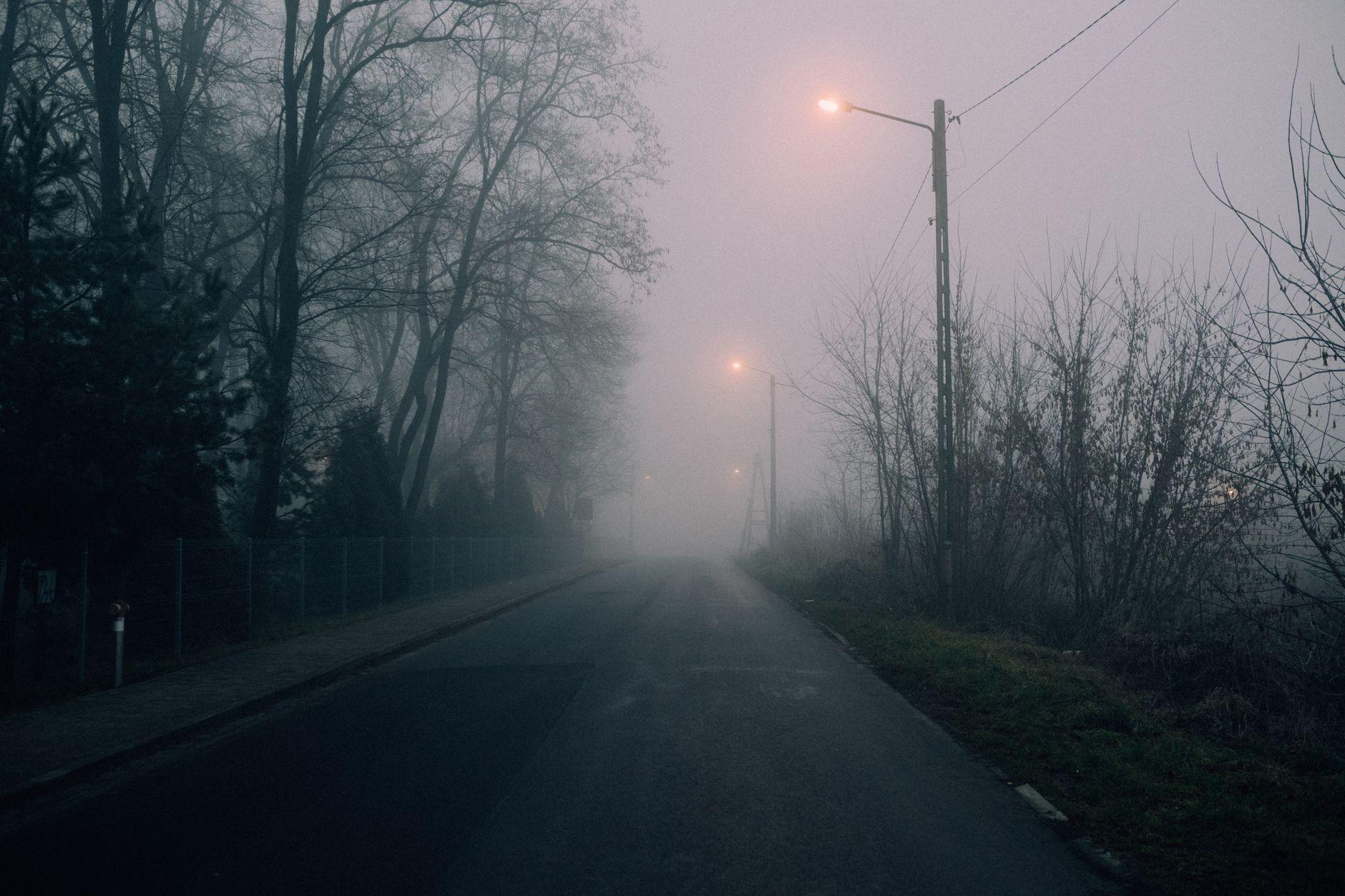
The finance on my cab is six hundred and twelve pounds a week, and in December you pay that by running nights. I haul pallets from the Melden distribution park to the docks at Corrin, ninety-one miles each way, and I take the old road over Brant Fell because the fell rate pays and the dual carriageway is average-speed cameras and roadworks this side of Christmas. The load leaves the park at 22:40. The Corrin window opens at eight, and the contract carries a penalty clause written by people who have never waited in a lay-by at four in the morning for a gritter the county no longer funds.
At the bottom of the fell, in the old coaching lay-by at Halewick, there’s a fish van. First light, its queue is all drivers. The man who runs it is Col, and he tells the rule to every agency lad who parks wrong.
This was a coaching road. A stage every twelve miles, and a wall round each yard to keep the horses in. The walls are down but the line is still in the ground — that grass hump you’ve just parked on. Stop inside it after dusk and you get stabled. Wagon, van, motorbike: anything that crosses the line stays till first light over the fell. You can walk out any time you like. The vehicle can’t. Park on the new tarmac, past the hump, and nothing touches you.
The agency lads laugh, and Col lets them. His proof hangs over the fryer, a photocopy of a recovery agent’s job card gone soft with grease.
CORRIN & DISTRICT RECOVERY — JOB 93/4182
Location: Stanedge lay-by, old road. Attending: M. Ellery.
Reported: HGV no start, driver on site since 21:40.
Battery tested: good. Immobiliser: good. No fault found.
Vehicle started first crank, 08:41. Driver declined recovery.
A wagon that won’t start for nine hours and then fires before the agent has his gloves off. A mate of Col’s vouched for the driver. You know how that goes.
The Grass Hump
The first Thursday of December I was two runs behind on a November backlog, and the fog came down on the fell so thick the cats’ eyes were the whole world. Somewhere above Scarside the tiredness got its hands on me. I rolled into the Halewick lay-by at twenty past two, up by the trough where the van’s light fell across the grass, and I set two phone alarms and the cab alarm for twenty minutes.
I woke in daylight.
08:12 on the dash. The engine was off, and it had not stalled — it had wound down the way a horse goes quiet when the harness comes off, nothing mechanical in it at all. The tacho card held a solid bar of rest from the minute the engine settled to the minute I woke, unbroken, entered, legal in every line. Both alarms sat there with full charge, unfired. The trough was filled to the brim, and the night had been dry.
I got out and walked. Nobody holds you. I walked down to the van for signal, took the bollocking, walked back up, and the wagon started before my hand was off the key. First light cleared the fell at 08:12; I know because I sat there with the dash clock and watched the sky come right at the same moment, the way you watch a kettle.
I don’t believe in anything I haven’t parked inside, so on the Saturday I tested it. There’s a flat patch of newer tarmac at Halewick, south of the hump, laid for the quarry traffic, and I stopped there at dusk with the alarms set again. Twenty minutes, engine on, in gear, hand on the door release.
Nothing.
Doors, engine, lights — all mine. I drove away exactly on plan, and the only thing wrong with me was that I’d spent a Saturday night proving a chip-van rule to myself. Before I left I paced the hump out, though. The old yard runs wider than the lay-by looks. The line comes out past the modern kerb at the north end, through the grass, and the two coach-stones stand at the corners like gateposts whose gate went away a long time ago.
The Axle
Stanedge is the top stage, a thousand feet up, all new tarmac, and what I hadn’t worked out is that at Stanedge the old yard bulges behind the kerb. The wall-line runs through the lay-by itself.
I pulled in for my 45 at twenty to midnight, tight to the modern kerb like the Highway Code owns the ground, and my trailer’s back axle crossed the line. I woke at 08:31 to a misted cab, a warm one, and another card full of rest I hadn’t chosen.
That night the trough was working. Long, unhurried drinking, then quiet, then the crunch of something shifting its weight on stone. I sat with the interior light off and my boots on the seat until two, then put my coat on and walked out — you can always walk out — two miles down to the crossroads where the signal lives, and called the office from the dark. The penalty letter came the next week. When I climbed back up, the wagon turned over before I was properly in the seat.
The dawn at Stanedge that morning was 08:31. Nine days off the solstice, and every one of them would be later.
First Light
The last window before Christmas was the 22nd, and the forecast put the pass at Scarside below freezing from 02:00, gritters on the dual carriageway only, and my 45 due before 03:20. I sat in the park with the engine running and did the arithmetic a driver does. Run the ice at four with a break out of hours and hand the traffic office my licence, or stable at Stanedge and release at solstice first light — 08:47 — and miss an eight o’clock window by forty-seven minutes, and the December payment with it.
There’s a bend at Scarside with a wall on it, and every driver on the old road can give you a name that went through it. One of them was a mate of mine off the Corrin ferry runs. The ice doesn’t care how good you think you are at three in the morning.
I chose the stable. Ran the fell with the load light behind me and reversed up between the coach-stones at ten past one, took my boots off, and slept the way the card says I did.
At ten to four I was awake and wanting signal, so I walked down with the head torch off — there’s enough star over snow to walk by — and from the bottom bend I looked back up.
The lay-by was full. Six wagons besides mine, a curtainsider, a tanker, and a little van with a dealer plate, all standing dark and square in the invisible yard, every windscreen misted from the inside, and on the road below them a long scatter of footprints going the way I’d come. Every driver had walked out. The vehicles stood at rest like horses that know the yard.
The release isn’t a sound. At 08:47, to the minute, the sun cleared the fell and six engines turned over behind me, one after another, unhurried, a yard waking by rota. The Corrin window had been shut for forty-seven minutes. The penalty stands, and the finance company and I will be getting to know each other across a table in the new year.
Before I drove down, the stabled drivers were standing round the bothy wall the way smokers stand round a bin. The wall is tallied: five-bar gates scored into the stone, older than the tarmac, and among the old gates there are fresh scratches, one per wagon per night. Col read them out like a register. He didn’t add one for me.
I did it myself, with my key, at the end of the freshest gate.
I still run the old road. The office pulled my cards in February — cleanest rest records they’d audited in fifteen years, and they asked what my system was. Stabling hours, I told them. The dawn is coming back ninety seconds a day now, and by June the hold at Stanedge will run four hours and nobody will tell this story with a straight face. Col tells it anyway, with my rig in it, to agency lads who park wrong. I don’t correct him. I sleep better in that yard than I do at home, and the trough is always full in the morning.
Read to the end. Some stories shouldn't be left unfinished.