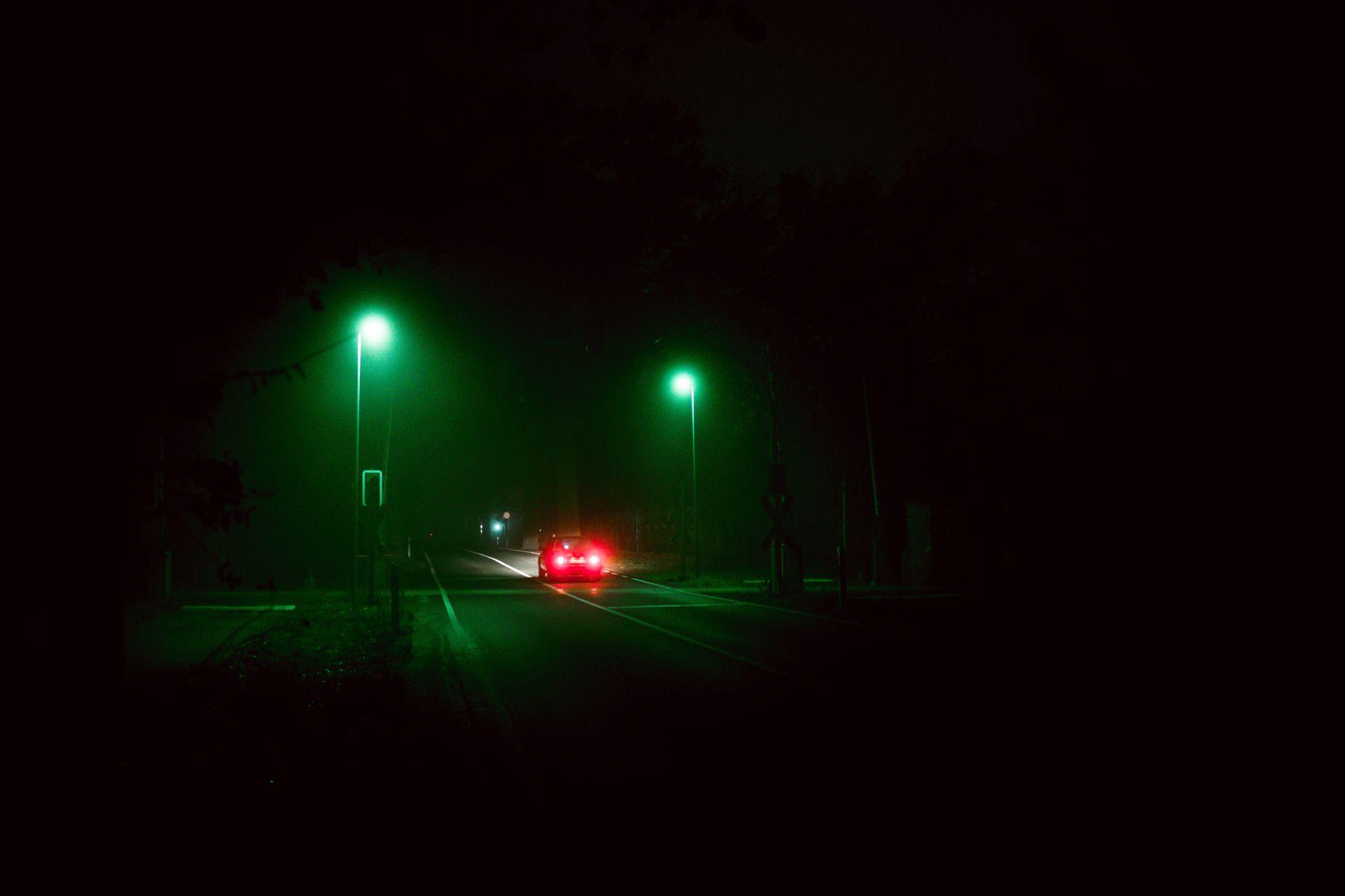
Fourteen Sets of Lights
The last visit of my round was Mr. Pardoe, 22:40, a bungalow on the north side of Alderfleet where the inner relief road bends in toward the river. Pneumonia in the spring, ninety-one, sleepless since. I took his obs, changed the dressing on his shin, sat twenty minutes while he told me about the herring yard his father had run below the bridge, and at ten past eleven I put my coat on.
Home was the far side of town. Fourteen signal sets on the relief road between his gate and mine.
Sam’s shift started at midnight. He drove the parts van for the depot at Carrick Lane, and our evenings met in the hallway for about four minutes, while I handed over whichever child had gone down — usually both — and he took his flask and was gone. If the lights ran against me I missed him. A small thing to want. I wanted it most nights.
In March the county switched on Clearpath. Adaptive control, said the leaflet on the surgery counter: seventy new signal heads learning the town’s traffic, junction by junction, minute by minute. The first fortnight was a shambles. Queues on Wharf Road reached back past the memorial gardens, the crossing outside the school cut its green man so short the lollipop lady wrote to the paper, and every patient at the Thursday clinic had an opinion. By May it had settled. The town ran, if not faster, then evenly, and evenly was what the county had paid for.
The first time was the Tuesday the football got called off. The ground stood dark, the streets were empty, and I came off the river bridge at eleven nineteen with every light ahead of me already green, and every one after that going green as I came to it. Fourteen sets.
Not one held me.
Door to door in nine minutes. I sat in the drive with the engine ticking, then went in, and Sam and I had our four minutes with time to spare for the first time that year, and I put it down to the match being off. Light traffic. The system breathing out.
It happened again on the Thursday.
And then it did not stop happening.
The Corridor
By midsummer the lights at Foundry Lane went green while the queue ahead of me was still three cars deep, and Saddle Bridge went green before Foundry Lane had finished with me, and so on down the river side, each junction clearing a few seconds ahead of my arrival, the whole run unrolling in front of the car.
For three weeks I blamed the schedule, which was the sensible thing. A nurse’s round is not a secret; the twilight service logs its visits, and the county knows when the town thins out. Except the town did not thin out on my account, and the cross streets had not read the schedule. The queue on Tanner’s Row grew from forty seconds to ninety. The man with the stop-and-go paddle at the roadworks near the school stood with his sign up and stared as I went past, three nights running, because the eastbound phase went green for me before he had brought his side to rest.
I tried to break it. I left the bungalow at half eleven instead of ten past, and the first junction went green at twenty to twelve — the corridor shifted with me. I took the long way, down Millgate and up past the allotments, and the lights on Millgate, which had run on fixed timing since before I was born, went green one after another down a street the county’s own maps class as an afterthought.
In July the alternator went, the car spent a week at Rushton’s garage, and Sam lent me the van. First night in the van: red at the bridge, red at Foundry Lane, red at Saddle Bridge, a quarter past eleven in the dark and ordinary as gravel. Whatever the system wanted, it did not want the van.
Rushton road-tested the car each evening while he had her, he told me when I collected her. Round the block, up onto the relief road, back to the yard. “She hits every green from the bridge to the co-op,” he said. “Every night. Same run. Nine minutes, near enough.” He said it the way he said most things, as a fact about an engine. He was in the car alone.
From the boys’ bedroom window, once they were down, I counted the three sets along the river stretch. At half eleven, ten minutes after I had turned off for home, all three sat at green. Holding, over an empty road.
Class Seven
Mr. Pardoe’s son worked at the signals depot. Matthew, forty-odd, down on Sundays; Pardoe kept a photograph of him on the sill in his maintenance orange, proud as anything. I stayed late one Sunday and asked, and before I had finished explaining, Pardoe had the phone off the hook and was shouting for his son.
Matthew rang the station on Tuesday. He had pulled the junction logs for the Wharf Road corridor, ninety days: stage times, detector actuations, the plate reads off the two enforcement cameras at the bridge. My plate was tagged in every record, carrying a priority field. The Clearpath tariff ran one to six — buses, fire, refuse on call, the hospital link, the school safewalk, one spare. Mine read seven.
“There’s no class seven,” he said. “It’s not in the configuration. Not in the commissioning pack, not in the migration notes. It sums up from somewhere, and the controllers honour it.”
He talked me through the mechanics on the phone, because he wanted the thing off his chest. The controller offsets each junction’s green so that a vehicle released at the bridge arrives at every stop line just as it changes. Buses got that once from a man in a control room with a stopwatch and a radio; Clearpath gives it to whatever it likes. Ninety days of logs, and the offsets ran for one plate.
I did what you do now with everything, and asked the council for my own data. Forty days later, one side of paper:
Following a search of our records, no assignment of a priority weighting to your vehicle is held by this authority. The weighting described is not present in the current configuration of the controller. We are unable to account for the junction behaviour you describe.
Mr. Pardoe fetched the committee minutes from the library, out of pride in his son’s office. One line in the September standing item:
Average junction delay on the inner relief road has fallen 14 per cent against baseline. The portfolio holder welcomed the figures and asked that the scheme be kept under quarterly review.
That was the arithmetic of it. A fourteen per cent fall, printed in the minutes, against one car the council’s own records said carried nothing.
Matthew wrote it up for the depot board — unauthorised priority class, cause unknown — and it went to the migration team, because October was coming and the county was moving everything onto the supplier’s new platform. Full wipe. Fresh configuration, built by hand from the commissioning pack. The ticket closed with the cutover: no fault found post-migration.
Three Dark Nights
After the changeover I sat at the lights like everyone else. Red at the bridge, red at Foundry Lane, the corridor gone, the town back to its even-handed queues, and Sam stood in the hallway with his flask in his hand and the door going at quarter to midnight.
On the fourth night the bridge went green as I came off it.
It came back the way a habit comes back. By the second week it began further out than it ever had, up at the north end by Mr. Pardoe’s road, and ran the fourteen sets to my street, and then went on. The twelfth set is my exit, the bottom of my street, and it held green while I turned, and the five beyond it ran green too, out along the Wharf Road toward the humpback bridge and the old toll house and the county line, with nothing on them. From the boys’ window, past the curtain, I counted them at half eleven, going green one after another down the empty road — junctions the county had retimed by hand in October, on a configuration built from a pack that has no class seven in it.
Matthew came for Sunday tea last month. I showed him the window. He stood in his coat for a while, and then he sat down and had his tea.
The corridor reaches one set further each week. Nineteen this week, then the twentieth out at Marsh Spinney, and after that the road runs out of streetlights and becomes the old turnpike, and from the window there is nothing left to count but the dark between junctions, going green for nobody.
I keep the printout in the glovebox: class seven, ninety days of junctions. Pardoe’s leg healed in August and the visits stopped, but I still come off his road at twenty past eleven, and the first set still goes green with the road empty ahead, and I still take the twelfth set for home and leave the rest running on behind me — green as far as the curve takes them, further out every week, on a road I have never had a reason to drive.
Read to the end. Some stories shouldn't be left unfinished.